Sequence and Series: Arithmetic & Geometric Progressions Mastery
Master university-level sequences, series, AP, GP, HP, Means Inequality (AM >= GM >= HM), Sigma notation, and infinite series applications (MTH 101).
- 4
- Chapters
- 15
- Topics
- 76
- Lessons
- 750
- Total XP
About this course
A comprehensive, highly structured 100-level university course in Sequence and Series. Designed for STEM students taking Elementary Mathematics (MTH 101 / MAT 101), covering sequence definitions and recurrence relations, Arithmetic Progressions (AP), common difference, arithmetic means, Gauss pairing sum formulas, Geometric Progressions (GP), common ratio, geometric means, finite and infinite GP sums ($S_\infty = \frac{a}{1-r}$), recurring decimals conversion, Harmonic Progressions (HP), the classical Means Inequality ($AM \ge GM \ge HM$), Sigma notation power sums ($\sum k, \sum k^2, \sum k^3$), and a dedicated final chapter with graduated calculation problems solved step-by-step with high-resolution mathematical diagrams.
What you'll learn
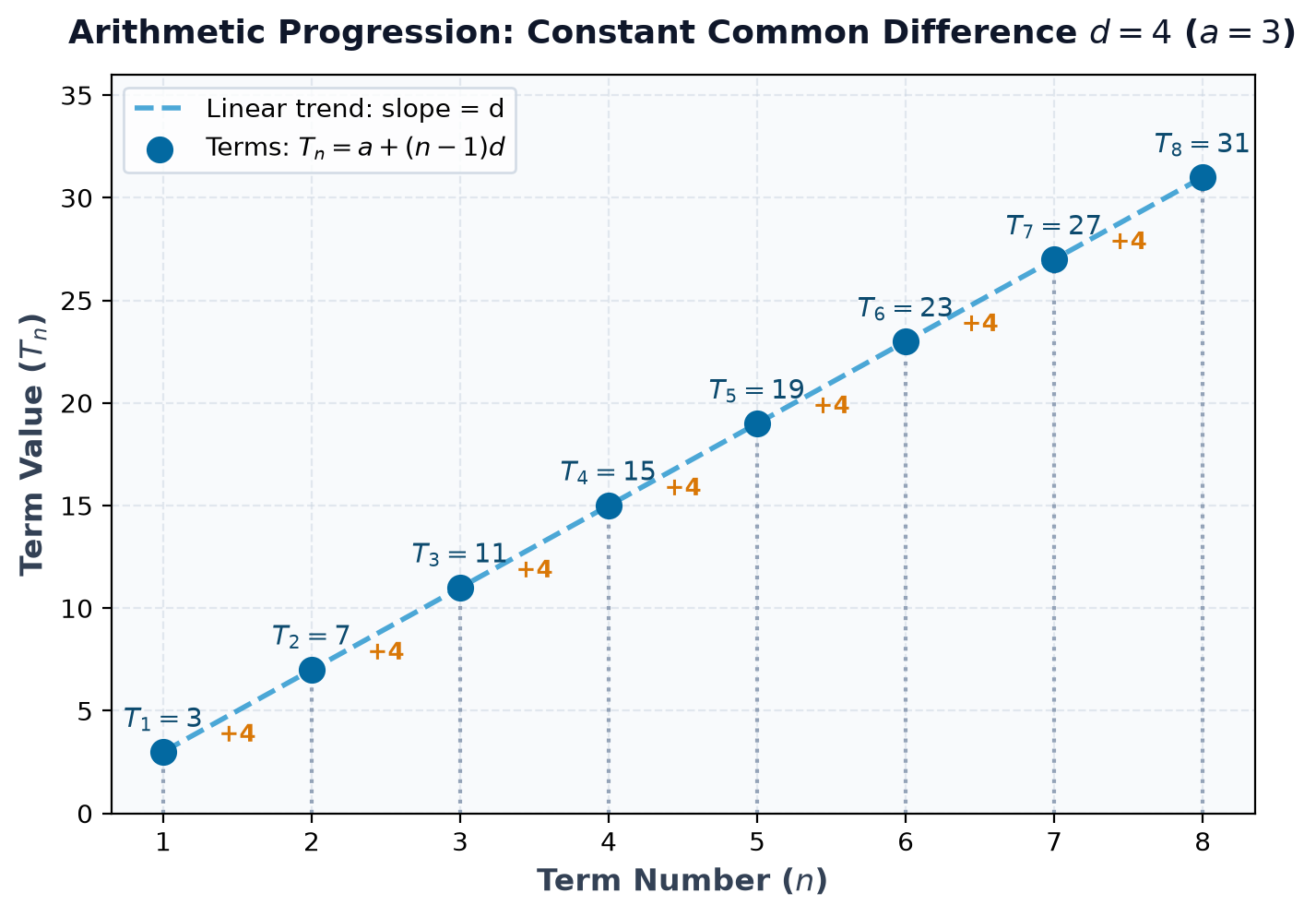
- Master arithmetic progressions (AP): find common difference $d$, any $n$-th term $T_n = a + (n-1)d$, and sum series with $S_n = \frac{n}{2}[2a + (n-1)d]$
- Master geometric progressions (GP): common ratio $r$, term formula $T_n = a r^{n-1}$, and finite sums $S_n = \frac{a(1-r^n)}{1-r}$
- Calculate sum to infinity ($S_\infty = \frac{a}{1-r}$) for convergent series ($|r| < 1$) and convert recurring decimals into exact fractions
Prerequisites
- Basic high school arithmetic and elementary algebra (linear and quadratic equations)
- Basic understanding of indices and fractions
Course outline
Chapter 1
Chapter 1: Introduction to Sequences & Arithmetic Progressions (AP)
4 topics
Chapter 1
Chapter 1: Introduction to Sequences & Arithmetic Progressions (AP)
Understand the mathematical definition of sequences, recurrence relations, arithmetic progressions, common differences, and sum formulas.
- 1.1 What is a Sequence? Notation, Terms & Recurrence Relations
- 1.2 Arithmetic Progressions (AP): Common Difference & The n-th Term Formula